Showing posts with label branding. Show all posts

Wednesday, January 16, 2013

Big and Small and Branding (with free advice for the Republican party)

Partially because of a pitch I just finished working on, where our ideas played with the notion of bigness, I've been thinking a lot about big and small. Specifically, I think these two words have an interruptive value: they can make you stop and reconsider things.

A classic example is the 'Think Small' ad to the left. The assumption the car buying public made at the time was that bigger is better, but this ad challenged the notion head on. It forces you to ask an obvious question: why, exactly, do I want or need a bigger car? Many people, I believe, answered it by saying they were shopping for bigness because of social pressures and not because they really wanted it. And so a smaller car made them feel not just frugal, not even smart, but like an individual. The word small didn't just mean physically smaller, but psychologically smaller, moving from a collective level of decision making to a personal one.

An interesting counter-example can be found in the cell phone business, where Samsung seems to be trying to stake out a place for itself as the 'big' smartphone maker. It starts, of course, with making a phone so big that some people question whether it is even practical, but a look at their ad will also give you a sense that (even though they don't use the word) they are trying to link that physical bigness to a sense of transformation, of expanding possibilities. It subverts the trend towards smallness that tends to rule in the technology space. But I think being more explicit about the value of bigness in a space that so often devalues it would have potentially been a lot more disruptive than their reliance on the oft-abused stand in, free.

Why are the notions of big and small so powerful in branding when used correctly? I think we can trace that back to the interplay between our desires for stability and progress. Our default position is to stick with what we know and our comfortable with. But we also don't like being stuck with something outdated, so we tend to assume certain trends: that cars will keep getting bigger or cell phones will keep getting smaller. In other words, we assume progress is linear and predictable, and buy accordingly. Marketers use those assumptions to keep selling new versions of their products. But sometimes products come along that flip the trend assumptions on their heads. What is a savvy marketer to do? Challenge the trend head-on, and give people reason to think that the trend is arbitrary or played out. Your departure from the norm isn't then lesser, or even just different, but bold, better: in short, a sign of radical, unexpected progress people can get excited about.

At some point in thinking about this topic, the wires in my brain that think about marketing got crossed with those that think about politics. It might have been this article that Jonah Goldberg wrote about federalism, and how absurd it is for the federal government to interfere in local disputes about things like the proper care arrangements for the six-toed cat population of Key West, Florida. He writes:
Federalism reduces partisanship by shrinking the importance of the federal government. It increases happiness by maximizing the number of people who get to live the way they want to live.Unfortunately, proponents of federalism tend to start the conversation with the really big issues: gay marriage, drugs, guns, abortion, etc.I'm for making all of those things local issues wherever possible, too. But, admittedly, those questions are complicated or emotionally freighted. Some questions do cut to the heart of what it means to be an American.  But many don't. So let's start there.
This struck me as an interesting idea for shaking up the political status quo. However, it has a branding problem. Support for federalism is often associated with the big issues he outlines, and supporters of local decision making are demonized: if, for example, you support federalism in the case of gay marriage, you are really a homophobe who wants to deny civil rights. If you support federalism in gun laws, you are really trying to take firearms from law abiding citizens one state at a time.

So, even though I am a supporter of federalism even in the case of big issues, I agree with Mr. Goldberg that we should start with the less controversial issues. I would go further to say that the taint that has been put on the word 'federalism' might require politicians to think of a new way to promote this cause.

A model for this would be the 'Big Society' movement launched by the Conservative party in the UK. They call this, "a massive transfer of power from Whitehall [the seat of their national government] to local communities." It plays off of the notion of 'Big Government', the idea that in an increasingly tumultuous and challenging world, we need a central power to set the rules that will make things fair and happy for more people. However, I think the challenge we face isn't that people don't like 'government', but that they increasingly don't like 'big'. So implying that society is going to get big implies shifting that stress to a different place.

Almost any institution that gets the word 'big' affixed to it is loathed. Not just Big Government but Big Business (and its tributaries like Big Finance and Big Pharma) and Big Labor. The word, in the context of institutions, has come to imply imbalance and heavy-handedness: the individual is simply too small to push back if one of these forces is arrayed against them. It also suggests facelessness. Who do you appeal to if Big Business screws you over? People are just tools of the system. Any individual bureaucrat might be nice enough, but if he can't help, there's nothing you can do. (Check out this article on rebuilding after Sandy for an example.) People are fed up with Big, and a lot of them feel like it's holding them back.

In the last election, a lot of people seemed to view Obama versus Romney as a choice between Big Government and Big Business, or as a choice between the poor and the rich. Neither of those formulations seemed to favor Romney. So, my promised free advice to Republicans: be the party of Small. Right now, they try to embrace Small Business, which is a start, but what about Small Decision-Making (the label might need work, but I mean keeping decisions and laws local as outlined in the libertarian argument above). What about Small Finance (breaking up Too-Big-To-Fail Banks and treating hedge fund earners like the rest of us)? I'll let someone else find the name, but what about acknowledging that there are only a few issues where government needs to dictate a uniform standard of morality to all 50 states and 300 million Americans? And of course Small Debt, which is self-explanatory.

The beauty of this platform, which I'll call the Freedom to Live Small, is that it allows people to campaign on big and popular principles while acknowledging that local beliefs might not support each manifestation of those principles. So a Republican in New Jersey can be personally in favor of tight gun control, but respect the right of Texans to live differently, and not be a hypocrite. I actually think it would be pretty refreshing to hear a politician on either side of an issue, instead of grandstanding, say, "We believe in X in my state, have passed laws that support it, but I see no reason to impose that belief on the entire country."

But the psychological benefits of Smallness go beyond any particular law that might be enacted (or avoided). It is a promise that we'll have fewer anger-fueled national arguments, that a flawed educational or economic theory won't hamstring the entire country for a generation if it is implemented, that we won't live our lives buckling under the pressure of one powerful institution after another. It is a promise that we can increase the level of mastery over our own lives, that smaller is simpler.

Maybe I'm crazy, and there's not much to this idea. If so, just chalk it up to me being a Big bullshitter.

Tuesday, November 27, 2012

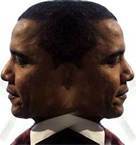
The Virtues of Being Two-Faced

Politicians are often accused of being two-faced, and President Obama is no different. In particular, his critics say, he calls for unity and bipartisanship out of one side of his mouth, while bashing his opponents as extremists from the other. But what if, rather than being a fault of a shifty politician, two-faced behavior is actually the hallmark of the successful and flexible leader? 

Reihan Salam writes persuasively that Obama demonstrates a trait common to well-regarded rulers from both recent and ancient history: an ability to convince allies he is still on their side even when he makes decisions that they disagree with. He concludes a long post by saying:
Perhaps sphinxlike leaders make the strongest leaders — allies see in them exactly what they want to see, thus giving the leader in question considerable freedom of action. Ronald Reagan’s political success arguably derived from the fact that his conservative supporters saw him as a loyalist and his moderate supporters saw him as pragmatic and flexible when necessary. In a related vein, Barack Obama commands the allegiance of a large number of base liberals, moderates, and culturally conservative minority voters because members of each of these potentially clashing constituencies see him as one of them.
He earlier notes that Obama was able to run ads in local markets that contradict some of his stated positions and would seem likely to offend his allies...and he did not suffer any criticism or loss of support from his core. For example, he ran some ads in Ohio that implied he was more supportive of coal than Romney, but environmentalists didn't blink. If Romney had similarly run an ad in Ohio expressing support for the auto bailout or for raising taxes on the wealthy, there's no way his political allies would have accepted it in silence.

How does Obama get away with seemingly pandering to win support like this? Salam's answer, in part, is that his allies either believe he doesn't mean it, or that he is simply making necessary compromises with political reality, moving the country as far in their direction as is possible. Another way of thinking about this is to say that, for many of his supporters, who Obama is matters more than what he says, or even what he does. And another way of thinking about it is that Obama has a brand that is deep and resonant enough to say seemingly contradictory things.

There are a few lessons marketers can learn about brand-building from Obama's achievement:

  • Be really clear about what you stand for, and have an argument for how your actions reflect your beliefs. Although many conservatives felt like Obama was disdainful and combative, he steadfastly stuck to his brand, which was the reasonable compromiser, the "adult in the room". It might have made his opponents want to throw a rock through their TVs, but by fighting to preserve that brand he was able to hold on to moderate voters despite widespread disappointment with the economy. Similarly, a brand that changes what they stand for every time a new competitor enters the market or the environment changes loses its credibility and coherence.
  • Understand how far your brand can stretch. Obama would never have been able to appeal to Tea Party types, and wisely didn't try. He found places where he could tweak his messages to appeal to low-attention voters or the undecided without violating his brand.
  • Identify the marginal opportunities using "Big Data". Writers have commented at length on how savvy the Obama campaign was in micro-targeting different slivers of the population. Often, they say that Obama was marketed like a consumer product. But a lot of consumer brands could learn from Obama's ability to address regional issues and go beyond broad ethnic and gender categories. Hispanics aren't just Hispanics, they are also women, and parents, and employees. Obama's campaign seemed to appreciate that people have composite identities, and they had the data (and budget) to act on it.
If you want to build a mass market for something, whether it is a politician or a product, it is unlikely that everyone you're trying to convert wants the same thing. So your brand has to have room for a lot of different facets or points of emphasis. Ultimately, a strong identity actually creates more room for flexibility in messaging, because your audience is willing to forgive individual messages that don't connect with them if they are invested in the brand. And if your competitors hear your diverse messages and call you two-faced? You should probably take it as a compliment.

Wednesday, August 15, 2012

Messaging verus Brand-Building: A Lesson from Politics

I've nothing original to say about the presidential race, so don't worry: this isn't that kind of a post. But I am curious about why our political debates seem so unpleasant and uninspiring, and why our trust in our leaders seems to be at an all time low. My contention is that we can track the problem to the constant polling and struggles to "win the news cycle": in other words an emphasis on messaging instead of--and in truth at the expense of--brand building.

David Brooks, in a recent column reinforcing a point made by Peggy Noonan, wrote about his "...attitude toward this presidential campaign: It’s incredibly consequential and incredibly boring all at the same time." He has a number of theories why, but I'd like to focus on one:
Third, increased focus on the uninformed. Four years ago, Barack Obama gave a sophisticated major speech on race. Mitt Romney did one on religion. This year, the candidates do not feel compelled to give major speeches. The prevailing view is that anybody who would pay attention to such a speech is already committed to a candidate. It’s more efficient to focus on the undecided voters, who don’t really follow politics or the news. 
Brooks doesn't get into how they target the uninformed, but I think we know: create a sensational claim about your opponent that fires up the media, and hope that the media will run with it to the point that it enters the consciousness of the uninformed voter. And, to drive the point home, run lots of ads echoing the attack.

As a marketer, I both understand this approach and am appalled by it. I understand because, unlike just about any other decision you make, presidential elections are a binary choice. The electorate "buys" one candidate or another. Individual voters have the option of staying home, but to a candidate's political operation, a non-voter is much better than a voter for the other guy, so that's alright. If, in contrast, I'm trying to sell a Toyota Camry, it doesn't make a whole lot of sense to attack the Honda Accord, because the buyer can just go and buy a Nissan Maxima (or buy nothing, which is just as bad for you as if they buy a competitor.) You have to make a sale, so you might compare when you're better (especially when you're "best in class") but you won't just go negative.

But, as I said, I find it appalling that a campaign would go this route, not from any moral squeamishness (though many attacks cross a moral line) but because it is ultimately counter-productive. To be an effective political leader, you have to be a brand.

The ironic thing is that Barack Obama aspired to be a brand in 2008. In the classic marketing formulation, a brand should provide a rational, emotional and self-expressive benefit. How did Obama want to do this? His rational benefit was that he claimed the power to bridge an increasingly divided America. His classic line was, "there is no Red America and Blue America, just the United States of America." In other words, he was a centrist, a pragmatist, and would find solutions acceptable to both sides. You could argue that this was the "change" he often spoke of: not just the change from George W. Bush, but the change from ideological conflict to rational, solution-oriented governance.

The emotional benefit he offered was his other buzzword, "hope". This tapped into something deep within the country's psyche, because I'd contend we were feeling particularly hopeless after the wars, natural disasters and economic strains of the Bush years. But to achieve the emotional benefit he aspired to, Obama would need to deliver on the rational benefit. Part of our hopelessness was that our very system seemed to be failing.

Let me explain self-expressive benefits before I tackle what Obama offered: they are essentially what affiliation with a brand says about you. Nike has a famous self-expressive benefit: when I wear Nike gear, I'm showing the world that I'm a committed, hard-working athlete. Obama had a unique self-expressive benefit. His supporters were able to say, "I'm the kind of person who sees past labels (whether Democrat and Republican or black and white) and makes a visionary choice." A vote for Obama was saying you were on the side of tomorrow.

But a brand has to be very careful not to over-promise, because people don't like it when they fall for a brand only to feel it has let them down. I'd say Obama's failure (in the minds of a majority of Americans) to deliver on his promised rational benefit has tainted the emotional and self-expressive benefits he offered. If I was giving him advice, I'd say that his best bet is to go out with a certain amount of humility, and say, "I think we've accomplished some important things, but I pledged to change the attitude in DC and that is, to put it mildly, still a work in progress. I haven't done that as well as I wish I had. But one big initiative of my second term is going to be (pick issue with broad bipartisan support), and I hope if I am fortunate enough to still be the leader of this great country, that my Republican colleagues will sit down with me, share their thoughts, and give my proposals a fair shake." If he was really thinking about his brand, that issue would be deficit reduction, and he'd find a way to make a proposal that would make at least some Republicans say, "Damn, that's not such a bad idea."

But it seems obvious at this point that Obama's strategy is to say that Republicans are impossible to work with, and that they want only to help the rich and return us to the bad old days of George W. Bush's presidency. He doesn't seem to care that his message is poisoning what is left of his brand.

So, what about Romney? His challenge is that he is an essentially cautious man, and those types of executives tend not to focus on brand-building because good brands take a strong position, and by nature don't please everyone. Even the company he started, Bain Capital, borrowed the brand name of a famous consultancy. So it's not surprising that his brand is poorly defined. There seems some chance that the selection of Paul Ryan as his running mate might help him to define it, but his lack of brand-building before the pick means the pair is vulnerable to being defined as benefit-slashing, heartless tools of the wealthy. I'd advise them to make their rational value "sustainability", though you could equally say "preservation" could work: essentially, that we are going to find ways to sustain America's greatness and America's promise to her people. Our entitlements, our security, our freedoms and our place in the world could all be defined as unsustainable on the path we're on now. I'd relentlessly make the point that both Republican and Democratic leadership have made decisions that put our wealth, our freedoms, our safety net and our security at risk, and the Romney/Ryan administration will retrench us in a way that they are on sure footing.

That easily enables an emotional benefit of: "unleashing potential". People want to believe that we could do a lot better, that the system or the decisions of our leadership are hamstringing us. Give them faith that you have a solution.

Republicans typically try to tap into a self-expressive benefit of patriotism: I think it's fair to say a lot of Republicans harbor suspicions that Democrats like the America that they think will exist in the future, when we fix it, not the country that exists now. My guess is you'll see that again this year, but I think that'd be a missed opportunity. It doesn't appeal to anyone worried about their job or their family or their debt. I think they need to make people feel that a vote for Romney is a vote for optimism. That not all our options are miserable, that we can rearrange things so that more people are more successful and happier.

The trick is, to build that type of a brand the Romney campaign would have to stop focusing on Obama's flaws and say how he would make things better. And have the facts and conviction to make the case compellingly, and keep making it despite all the fleeting issues that will pop up during the campaign. But there is no reason to expect this to happen. Instead, we should anticipate the daily messaging efforts to continue. Here's Brooks again:
Both campaigns fervently believe that more spending leads to more votes. They also believe that if they can carpet bomb swing voters with enough negative ads, then eventually the sheer weight of the barrage will produce movement in their direction. There’s little evidence that these prejudices are true. But the campaigns are like World War I generals. If something isn’t working, the answer must be to try more of it.
 Maybe things will change, but it is more likely we'll keep getting messaged by both sides, and keep feeling worse and worse about where our politics and our country are going.

Thursday, May 24, 2012

Believe in Digital, not Facebook

In my own modest way, I'm something of a digital evangelist: I think marketing, even in conservative areas like healthcare, will be fundamentally a digital activity by the end of the decade. And what does it mean for marketing to be digital? Simply that it is targeted to the point of personalization, highly measurable, and allows a big role for customer interaction and feedback. I think a lot of people who would basically agree with that description look at Facebook, and its over 1 billion users, and believe that they're looking at the future of marketing. And yet I think Facebook is ultimately way over-valued and will be a small part of most brands' marketing budgets. So how can I believe in digital and not in Facebook?


Now, lots of people don't like Facebook. Some of it is jealousy: you can't make $100 billion in your IPO without bringing out the haters. (Of course, some people are upset because it now seems their initial valuation might have been based on withholding some more negative forecasts.) But I am on record as hating Facebook before it was cool, writing about how Facebook may not be able to live up to the hype back in 2010, and last year speculating that Facebook's brand will not allow it to become a place where people buy things. My dislike is grounded not (just) in jealousy, but it real questions about their business model.


If I were to break down the logic that has made so many people think Facebook is worth so much, it is this: they have gotten a billion people to reveal tons of information about their lives, which will let companies conduct personal marketing at scale, reaching millions of relevant customers with exactly the right message. But one of my favorite authors, David Goldman (aka Spengler) makes an interesting point challenging that assumption:
No one is likely to learn much about anyone else by reading their Facebook page, or, indeed, by becoming their Facebook "friend". A Facebook page is constructed to maximize our appeal and white out our warts. We learn as little from the pages of Facebook "friends" as prospective employers learn about job candidates from a resume.
Later, he crystalizes the central paradox of Facebook:
[Facebook] attracts hundreds of millions of users by providing them with a platform for narcissism and the means to lie about themselves more persuasively, but it hopes to make money by learning what it is that they really like, the better to show them advertisements. Sadly, the system is worth a great deal of money, but not 100 times earnings.
I said earlier that digital marketing has three pillars: personalization, measurability, and interactivity. Facebook superficially seems to offer those things, but does it really? As people worry more and more about what their Facebook profiles are telling marketers (and family, and potential employers) they are likely to curate their digital selves more and more, stripping out a lot of the quirky or embarrassing details that would help marketers understand them as individuals. So much for personalization.


But Facebook is certainly measurable, right? Well, you get a lot of data from marketing on Facebook, which is good. But unlike search marketing on Google, for example, there isn't a clear answer for the question, "How much is a Like worth on Facebook?" People who really get it know you can probably define the value of that relationship for your brand if you're willing to crunch the numbers, but what people want is someone to say, "It's $8!" so you can build some assumptions into a marketing plan. But I would contend that since any marketing activity on Facebook (for most brands) is going to be geared towards generating goodwill and brand equity, rather than a direct response sale, measuring the value of Facebook marketing is going to be as squishy as measuring other forms of brand-building tends to be.


Finally, interactivity. Surely Facebook wins here, right? Well, for some brands. Brands that can take a point of view and be controversial, or have a large enough "cool factor" that those folks using Facebook as a personal advertisement want to associate with it. But there's a catch: the more brands that are in the conversation, the less attention there is for each brand. And unless you can define a unique audience segment you want to talk to and be consistently relevant and interesting, you're likely to be talking to yourself. So while some brands may develop a cohort of engaged followers, Facebook can't guarantee followers the way TV can guarantee eyeballs or Google can guarantee clicks.


Maybe so maybe there's a reason that a lot of companies, most recently GM, are saying that their Facebook ads aren't working. Of course, it might be that they don't know how to use the platform, but if a large and sophisticated company like GM fails on Facebook, we should expect a lot of other marketers will, as well. That hardly makes it a universal platform, and calls into question whether it will ever live up to that huge valuation.


I believe Facebook can be a tool to help you find your audience in the digital world, but it is hardly the only tool, and it frequently may be the wrong tool. It has fundamental limitations that will keep it from being a one-stop shop for marketers. But digital is much, much bigger than Facebook: it includes everything from online video to search and display ads to niche social media to this humble blog, and within those multitudes is a solution to most any marketing challenge. So go ahead, doubt Facebook along with me if you'd like, but don't let that stop moving you towards the digital future.

Tuesday, April 10, 2012

Reflections on My Next Decade in Advertising

Last year, I wrote two posts about the state of the advertising industry, and why I felt like it might be a good time to get out of it. At the time, I was moving to Google, and wondered if and when I would ever haunt the halls of an ad agency again.

It didn't take very long. I'm now back at my old agency, and as I reread those two posts this morning, I started thinking about what was right and wrong about my not-so-old take on the business. So I wanted to take the time to revisit those ideas, and sketch out why I think advertising has a bright future.

First, a note for those of you who think that advertising as a business is going to be dismantled by tech companies like Google: you are missing out on amazing opportunities to build brands and do more meaningful work because you're in love with old, unaccountable media. Right now, media supply is the constraining factor for most marketers, meaning you have to spend a lot to connect with the right people. With the improvements in targeting (which moving into the offline world as well) along with the explosion of engaging content, it will be increasingly possible to spend less in reaching your audience. With less money going into buying your reach, it leaves more to create content your audience might actually enjoy, even seek out. This should be a great thing for advertising agencies. (And if you don't believe this is possible at mass audience scale, don't believe me, believe P&G, which has already moved pretty far down this path.)

Second, a little bit of self-criticism. Last year, I wrote:
What do I mean about 'relationships before reach'? Simply put, that the number of people who saw your ad is no longer the standard for evaluating success. A campaign should be winning over converts, true believers who will help advocate for your brand. If you have a great product, this is very doable. Just create the story of why your product can improve your customers' lives, put the product in their hands, and watch the fireworks. (Easier said than done, I know.)
This now strikes me as a bit of digital magical thinking (and there's a lot of that out there) that isn't supported by the way we actually live. For example, I'm a big fan of Narragansett Beer. I follow them on Facebook, read their blog, and ask for my wife to go out-of-state to buy me some as a Christmas present. I am as much of an advocate as they can reasonably hope for, and yet as far as I can tell I haven't influenced anyone to go out and buy the stuff. Now, I'm sure they have other advocates who do drive sales for them, but activating your true believers is not often going to be enough to build your brand in a competitive marketplace unless your product is truly extraordinary. Like, "This pill made me grow five inches, cleared my skin, boosted my IQ and healed my broken leg," extraordinary. Otherwise, you're still going to want to get your message out their to a lot of people who have never heard of you before, which means reach still matters. A lot.

So what is the next decade going to hold? Well, last year I wrote: "What is this illness [in the advertising industry]? In short, it is a business model that is predicated on gaining efficiencies through scale, when that scale is likely to prove inefficient for the indefinite future."Advertising folks have made a lot of money because they could navigate the complexities of the 20th century communications world and get a message out there. As I wrote then, there is going to be pain as the models built up over decades collapse. But we can now reach consumers more efficiently, though the path to do so is often even more complex than the old model. So, I anticipate spending the next chunk of my career answering two questions:
  1. How do we reach the right people at the moments when they're receptive to what we have to say?
  2. How do we delight them once they've given us their attention?
A few people have started to figure this out. But there's lots of room for innovation, and the only sure way to fail at it is not to try, while the path to success probably involves failing fast. (By the way, I predict "fail fast" will become the new "think outside the box" in the next few years.)

My bedrock belief is that audience attention has replaced media spend as the limiting factor on advertising's success. So our starting question has to evolve from, "What do I want to say and where can I tell it to my audience?" to, "What does my audience care about and how can my brand connect with that?" That shifted focus will cause a cascade of other changes in the business, but ultimately make advertising more enjoyable to make and to consume.

But I'm still thinking all this through, people, so feel free to try and change my mind. Where is advertising going, and how do we get there?

Tuesday, May 3, 2011

Three Cups of Tea, Branding and Our Desire to Believe

Why are we so quick to believe liars and fabricators? We are plagued by journalists who invent facts and sources, by politicians scurrying to bury scandal, and by memoirists who find their lives are best seasoned by liberal doses of fiction. Into this last bucket place Greg Mortenson, author of Three Cups of Tea, founder of a charity intended to build schools in central Asia, and--as 60 Minutes revealed in a recent expose--a fabulist and a crook.

What is amazing, as this post by Bruce Bawer makes clear, is that the improbability of his story should have been apparent to even a casual observer:
[Mortenson] was the star of his own story. The whole point of his talk was how much one brave, selfless individual can accomplish in this world even against the most formidable of odds. And that individual was him. The premise of his spiel was that he’s a miracle worker, pacifying belligerent jihadist types by sitting down with them over three cups of tea and listening to their concerns. Yet the egomaniac I saw that day was somebody you couldn’t picture listening to anybody else for more than thirty seconds. Mortenson’s shameless self-celebration in Three Cups of Tea left me speechless. As Oscar Wilde observed of Little Nell’s death in The Old Curiosity Shop, how could any sensitive reader react to such nonsense with anything but derisive laughter?
Bawer continues by showing how callously Mortenson turned on those who had been kind to him to bolster his own reputation:
Then there’s Mortenson’s lie about having been kidnapped by the Taliban. He stuck a picture in his book of him and some Afghani acquaintances — who had treated him kindly — and identified them in the caption as his kidnappers
When we hear stories of people using others this way to bolster their own stories, we are rightfully disgusted. When we hear, as in Mortenson's case, that he was doing it in large part to enrich himself, and use his charity to support a lavish lifestyle, we howl for blood. But why do we buy in to begin with? It is easy to say, "We want to believe," but why? Wouldn't it make more sense for us to be exceptionally skeptical, and to disbelieve even true stories to protect ourselves from fraud and disappointment? Why, in other words, are humans so quick to trust?

Part of the answer, as David Brooks and Mark Earls and many others have pointed out, is that we are social creatures. We essentially outsource some of our decision-making to others. So if enough people tell you Greg Mortenson is a hero, you may not evaluate that claim very critically yourself before you, too, are singing his praises.

But I think it goes beyond that. People don't just have their small social groups, they love to organize themselves into big, abstract teams, teams that are defined by a series of positions its members are either for or against. Successfully aligning with these positions is the key to popularity for both brands and people.

Look, for example, at how Microsoft and Apple fostered opposing tribes of believers on the basis of different operating systems and technical specs. Mortenson did the same thing by aligning with deep-held beliefs in non-violence, in the power of the individual to make a difference, in multiculturalism. He pushes against the idea of cynicism (or what some would call realism or humility) and an us-versus-them mentality.

This places him squarely on the liberal-idealist team, which has many players in academia, in government, and in Western urban culture more generally. Many of these people struggle to solve the seemingly intractable problems in society, and are understandably inspired by someone who seems to be taking on big challenges with verve and success. Mortenson's story reflects their beliefs and aspirations so perfectly, they were desperate for it to be true. (Similarly, eight years ago who took what was commonly called the 'neocon' worldview really wanted to believe the Iraqi people were going to "greet us as liberators.")

We should remember that people (and brands) are not perfect. So if their stories are perfect, it should set off our BS warning sirens. The lesson is that we can't just investigate our enemies and be skeptical about those we don't agree with. To avoid our natural tendency to believe, to accept social decisions, and to take sides, we need to bring a critical eye even to those we want to love.

Tuesday, April 19, 2011

Building Authorial Brands

After a few years on the outside looking in at the publishing industry, I have to admit I am flummoxed: why does it seem so hard for authors to take advantage of the new technologies out there to build their careers? Why does the publishing industry view digital technology as a threat instead of an opportunity? And how come books are more like wine and less like whiskey?

Ok, let me start with the last one, first. I drink both wine and whiskey. (I'm surprised my wife doesn't come out of her dead sleep right now to shout, "and too much of both!") I have been enjoying wine since a trip to Italy in 2004. Whiskey is a more recent hobby, something I've only been trying for the last two years. And yet I feel much more comfortable picking out a bottle of unfamiliar whiskey than a wine I've never tried before. Why?

It's simply because whiskey operates under a few relatively simple rules that help me to categorize it and find what I like: it could be scotch or bourbon or rye. If I want a scotch, I could go for a single malt or a blend, and know exactly what I'm getting. There are a few simple descriptors that give me a good sense of what I'm getting. Wine, on the other hand, seems endlessly complex, and thus remains intimidating. Books are the same way: other than the broad categories like 'romance' or 'fantasy', what guide is there to help me try a new author on a whim? No, you have to do research: read reviews, ask friends, what have you. One would think modern technology would help with this, but not really. (I will say that Amazon's recommendations are a step in the right direction, but unless you buy a lot they seem wildly speculative.)

Let me offer one example relevant to my efforts as a struggling writer of science fiction. The magazine I spend the most time with is Asimov's, which I'd say has a 50% 'hit rate' for me: 50% of what they publish, I like. I consider that pretty good. And yet I have not bought a book on the basis of those stories, though many of the authors have books out, and many are published repeatedly so I have a good sample of their work. And that's mostly because the magazine makes no effort to encourage that behavior, and neither do the writers, other than putting a bio at the beginning of their stories. Why isn't Asimov's looking to actively promote some writers, and have a stake in their success? Why don't they seem much interested in promoting a specific "Asimov's Style" that would reliably please readers and build a more consistent brand experience? As it exists, the magazine (and all the others I've found in the fiction world) seem to exist as a checkpoint for writers looking to get along to a book contract, where they will start from scratch in building their audience.

There is an opportunity for writers, magazines and book publishers to form an alliance that would serve all parties. But each group should be looking to build a more reliable, recognizable brand that consumers can trust. If they do, the electronic world we are entering will offer rich opportunities and many satisfied (and paying) readers for all sides. If not, we'll continue to hear whining about the decline of publishing.

Monday, March 14, 2011

Brand Clarity, Profit, and Facebook

Amazon was founded to sell us books, and eventually expanded into selling us other things we didn't want to search through a store to get. It makes a ton of money. Google was founded to make search easier and better, and eventually expanded into providing other tools that make content gathering easier and better. It makes a ton of money. The two most successful Internet firms may now do lots of things, but the vast majority of their profits come from finding new places to apply the same basic template that has made them successful. (And, as an aside, when Google tries to do things like set up a social network, it hasn't been nearly so successful.)

Facebook was founded to connect college students to each other. (When I was in college, the "Face Book" was a picture book of the people in your class that everyone looked through to figure out who they wanted to, well...let's say meet.) It eventually expanded to let anyone use the service and connect to other people. And they have made some pretty good money doing this. Although they do it by selling ads that have a remarkably poor click-through rate, which has started making people wonder if that type of promotion is really worthwhile or just chasing buzz.

But Facebook has a problem: it is the most hyped company in the world right now, and is valued at many, many times its earnings. It has to figure out a way to turn 'social' into 'revenue' without turning off its users. If the ads don't really work, how do they do this? Well, they could try to give marketers more information about their users. That information is very valuable. But if they do that, a lot of people (who don't want Procter and Gamble sending them a toothpaste coupon if their status says they have coffee breath) will leave the site.

Another option is to sell other services through the site. To this end, they have developed a virtual currency called a Facebook Credit (which reminds me a bit of a SchruteBuck), which can be used to buy upgrades on games like Mafia Wars and Farmville, and now can also be used to rent movies through the site.

Then there is the option of snatching bits of other companies' business models and aggregating them in Facebook. After all, Facebook has a huge built in user base. Their first target, Groupon, which gives daily discounts off of local services like restaurants if you buy in advance. Facebook plans to expand its existing Deals program to get in on the action.

Here's the thing: none of these initiatives (with the possible exception of buying a new Tommy Gun on Mafia Wars) has anything to do with staying connected to friends. And in some cases, it may actually get in the way of that core mission. If your Facebook page starts filling up with Deals based on what you and your friends are doing and discussing, are you going to be happy, annoyed, or creeped out?

But the bigger issue is that the Facebook brand isn't about shopping, or renting movies. It's about sharing a bit of your life with people you know, and staying in touch with them in return. Groupon was designed to sell me stuff, and so I don't mind when it does. With Facebook, I'll mind. Modern Internet users have gotten very good at compartmentalizing the brands that they use for different online tasks, and it may just be Facebook's fate that it is the place to waste time and joke with friends, not the place to spend money.

Wednesday, January 26, 2011

SOTU Part 2: Politics and Brands

First, thanks for the feedback on my last post about Obama's reelection prospects. For those of you who thought I might be over-thinking it a bit, I refer you to Daniel Henninger's latest, who basically says, "Obama is putting a moderate frosting on the same big government cake." That could well be true! But I think he wants to appease the center and get re-elected, and my point was that the Tea Party will ensure that symbolic gestures and half measures don't get much traction, so to get anything done he will have to make substantial concessions to the Republicans.

Underlying that post was some thinking about brands which I wanted to make explicit. Right now Obama is virtually synonymous with the liberal brand. (Nancy Pelosi could have staked a claim while she was speaker, but she's faded from the picture rapidly in the last few months.) Another way to put it is that Obama has a monopoly on the liberal market: if you're a liberal who wants to 'buy' a different option, where do you turn right now? Even Keith Olbermann is off the air. And like all monopolies, the Obama brand has gotten a little flabby. Is he the bipartisan uniter? The new Kennedy? The racial healer? The smartest guy in the room? The professorial President? The empirical pragmatist? All of these ideas have been floated in the past year or so as the Obama brand, but none of them really define him. Which is good for him to the extent it means he can redefine himself (again, as I argued he's doing in my last post. But it is bad for him to the extent that he can't rally the public behind his brand.

In contrast, I think the competition between the "Standard Right" Republicans and the Tea Party helps them to define their brands. Both groups want to control the more conservative side of the political spectrum. But, as you could see from Paul Ryan's speech last night, the Standard Right are trying to be the responsible adults who have learned from the past and are ready to fix America's problems, especially it's deficit crisis. And while the Tea Party also wants to take on the debt, their brand is much more about restoring America's founding vision and throwing out the 'impure' elements that have corrupted the country.

To the extent that this isn't just rambling, here's the point: the Republican 'brands' have similar goals, but they are quite distinct in tone and values, and they are competing for the same audience. Obama, meanwhile, as no competition for his audience. The competition, I think, will force Republicans to evolve and improve their thinking and their brands more rapidly, and I think ultimately help them succeed in the marketplace of ideas.

So the lesson for marketers: embrace competition, and use it to help you define who your audience is and why they should care about your brand more than the competitors.

Tuesday, October 19, 2010

What Soccer Can Teach Us About the Value of "The Best"

Word came recently that my beloved Red Sox are close to buying Liverpool, one of the soccer (I should say football, especially since I'm in Europe) clubs in the English Premier League (EPL). While I would prefer that the Sox owners put the money into acquiring a few stronger players, I understand the business motivation: after the last World Cup, there is (again) talk that soccer is finally catching on in America, and investing in a premium franchise, and in an English-speaking country, makes sense as a long-term play.

Well, so I thought, to the extent I thought about it at all. The essential logic is that the EPL represents the best in soccer, and that those franchises will only continue to increase in prominence and importance. Numerous books on business and branding have noted the phenomenon that the rich get richer, that there are many industries where winner increasingly takes all, and the most successful, the most powerful, the most well-known increasingly get more money and fame while second-best fades.

However, this column by Theodore Dalyrimple, ostensibly about the World Cup, caused me to reconsider. The key point:

There is also an interesting contrast between the way the professional sport is practiced in Germany and in England.

The English football league generates far more money than the German, and most observers deem it the best in the world, at least in terms of attracting hundreds of millions of television viewers. Players in the English league are much better paid than those in the German league (though the Germans are hardly impoverished). However, most of the players in the top echelon of the English league are foreign. Many of the best clubs have only two or three English players, and some have none. English clubs import players; German clubs foster and train German players. English clubs are largely owned by foreigners, such as Russian oligarchs of the most dubious reputation; German clubs are owned by Germans. English clubs lose money and are highly indebted; German clubs make a profit and have monetary reserves. And as I have already mentioned, the German national team plays incomparably better than the English national team.


As a marketer, I have to think that the German teams (and German soccer) as brands, are in the stronger long-term position. They are authentic, local, and sustainable, all modern branding buzzwords for a reason. One could imagine a future in which the EPL fans grow disenchanted with their crazy owners (who aren't English) and pampered players (who aren't English) and see their league as fatally compromised. One could also see a future in which the unsustainable financial practices of these teams cause a paring back, with the best talent going to other leagues, including the German ones, and cutting into the EPL's talent advantage.

If John Henry and the other Red Sox owners wanted my advice (which of course they don't) I would tell them not to invest in a bubble inflated by foreign money chasing "the best". They should try to be a part of building something (which is what they've done with the Sox) rather than buying at the peak of a sports bubble. They might even think about using some of that money to build soccer in the US. But I think they'll find the value of owning the Liverpool 'brand' will be much less than they think.

Friday, February 5, 2010

Only Be Different

I find politics an interesting place to study communications because all the polling and elections provides rich feedback as to what works and what doesn't. And right now, we are clearly searching for novelty. Look at the low poll numbers for each party, look at the unpredictable voting results (Obama won Indiana and North Carolina in 2008, Republicans won major races in New Jersey and Massachusetts in 2009).

Which is why I find the current strategies of both parties so pathetic. The one thing they seem completely unable to deliver is novelty. Now I don't mean novelty for its own sake, I mean looking at the issues and proposing a completely new, bold solution instead of rehashing previous positions (like the Republican's latest plan.)

Imagine, for example, if someone came out and said, "I propose a two year hiring freeze on all federal government jobs outside the military." They'd have your attention, right? Or, to take on another issue, "I propose every American under 65 have 'catastrophic health insurance' for any illness or injury with average treatment costs over $100,000." OK, one more: "I propose that the government stop issuing marriage licenses and provide domestic partner licensing to any two people who want it."

Now, I chose those as examples because they represent three points I believe in, but they may not fly as national policy. But any politician who said them would instantly get more attention than a Republican who talked generically about tax cuts or a Democrat pushing for a healthcare 'public option'. Because those ideas are old, stale, and predictable.

In marketing, we constantly ask if an idea is 'differentiating', but we use the word incorrectly, to mean "can my competitor say this, or have they said something similar?" But the real definition of differentiation should be "would this create a powerful sense in my audience's mind that my brand represents something unique and valuable?" If we're going to expend the time and money to say something, we should ask ourselves if it will strike anyone as truly different.