Monday, November 1, 2010

Retreating to Psychology

My daily reading tends to cycle rapidly between political commentary and sports writing. Today, I read two pieces that demonstrated to me just how much of my life I am wasting on reading other people's dimestore psychologizing about public figures of all sorts. First, here is Maureen Dowd on President Obama:

His arrogance led him to assume: If I build it, they will understand. He can’t get the gratitude he feels he deserves for his achievements if no one knows what he achieved and why those achievements are so vital.

Once it seemed impressive that he was so comfortable in his own skin. Now that comfort comes across as an unwillingness to be wrong.


And here is Bill Simmons on Dwayne Wade:

The overthinking-it-but-maybe-I'm-right explanation: Maybe everyone slowly realized during the preseason, "Good God, LeBron is MUCH better than Dwyane. What do we do? How do we handle this? Do we wait for Dwyane to admit it? Do we ... wait, what do we do???"

Maybe Wade can feel it. Maybe his competitive juices are kicking in. No, no, we're equals. He's not better than me. We're equally good. Look, I'll show you. Maybe it's just been the elephant in the room for six weeks. Maybe deep down, everyone knows the Heat can't take off until Wade has his "You can be chairman and CEO, I'll be president and COO" moment. It goes beyond who gets to take the last shot. It's about the dynamics of basketball. It's about someone emerging as the emotional leader, the spine of the team, the guy who says over and over again, "I got this." And you can't keep saying that if you're looking over your shoulder worrying that someone else is saying the same thing. It's like a fly ball in the outfield. Eventually, someone has to call it.


In case you don't feel like clicking through to the whole pieces, I'll give you a summary. Dowd's point is: Obama was too cocky and believed his own hype and now he's paying for it. Simmons' point is: Both LeBron and Wade are used to being the star, and one of them is going to have to defer to the other if they are going to succeed. Both of these themes are so obvious and well-worn that if they had written their pieces without resorting to pop psychology, they wouldn't have been much longer than those sentences.

Why is psychological speculation so compelling to readers? Sadly, I can only answer the question by resorting to it myself: readers today are overwhelmed by how complex and challenging things have become, so they take comfort in speculation as to behavioral drivers that they can easily understand. We may not be able to figure out an agenda that will both help the country and appeal to Obama's political base, we may not be able to envision an offensive system that will maximize the combined talents of LeBron James and Dwayne Wade, but we can presume that we understand what's going on in the heads of famous people, and that makes us feel smugly superior to them. At least I'm not as cocky as the President (or Dwayne Wade).

There are writers who make more substantative arguments: Walter Russell Mead is a great example of someone using historic and strategic insights to help his readers understand what is happening in the world right now, and what might happen in the future if certain trends continue. His recent post about the sorry state of our politics, and the structural weaknesses of both parties that keep them from addressing our major problems, was compelling and avoided cheap point scoring. But as long as we continue to indulge our collective intellectual laziness by analyzing why our public figures don't behave exactly as we'd like, we will remain hopelessly far from finding new solutions to our tired problems.

Tuesday, October 19, 2010

What Soccer Can Teach Us About the Value of "The Best"

Word came recently that my beloved Red Sox are close to buying Liverpool, one of the soccer (I should say football, especially since I'm in Europe) clubs in the English Premier League (EPL). While I would prefer that the Sox owners put the money into acquiring a few stronger players, I understand the business motivation: after the last World Cup, there is (again) talk that soccer is finally catching on in America, and investing in a premium franchise, and in an English-speaking country, makes sense as a long-term play.

Well, so I thought, to the extent I thought about it at all. The essential logic is that the EPL represents the best in soccer, and that those franchises will only continue to increase in prominence and importance. Numerous books on business and branding have noted the phenomenon that the rich get richer, that there are many industries where winner increasingly takes all, and the most successful, the most powerful, the most well-known increasingly get more money and fame while second-best fades.

However, this column by Theodore Dalyrimple, ostensibly about the World Cup, caused me to reconsider. The key point:

There is also an interesting contrast between the way the professional sport is practiced in Germany and in England.

The English football league generates far more money than the German, and most observers deem it the best in the world, at least in terms of attracting hundreds of millions of television viewers. Players in the English league are much better paid than those in the German league (though the Germans are hardly impoverished). However, most of the players in the top echelon of the English league are foreign. Many of the best clubs have only two or three English players, and some have none. English clubs import players; German clubs foster and train German players. English clubs are largely owned by foreigners, such as Russian oligarchs of the most dubious reputation; German clubs are owned by Germans. English clubs lose money and are highly indebted; German clubs make a profit and have monetary reserves. And as I have already mentioned, the German national team plays incomparably better than the English national team.


As a marketer, I have to think that the German teams (and German soccer) as brands, are in the stronger long-term position. They are authentic, local, and sustainable, all modern branding buzzwords for a reason. One could imagine a future in which the EPL fans grow disenchanted with their crazy owners (who aren't English) and pampered players (who aren't English) and see their league as fatally compromised. One could also see a future in which the unsustainable financial practices of these teams cause a paring back, with the best talent going to other leagues, including the German ones, and cutting into the EPL's talent advantage.

If John Henry and the other Red Sox owners wanted my advice (which of course they don't) I would tell them not to invest in a bubble inflated by foreign money chasing "the best". They should try to be a part of building something (which is what they've done with the Sox) rather than buying at the peak of a sports bubble. They might even think about using some of that money to build soccer in the US. But I think they'll find the value of owning the Liverpool 'brand' will be much less than they think.

Wednesday, October 13, 2010

The Incentive to Mediocrity

In my last post, I argued that greatness is increasingly unlikely to occur when society rewards talent so lavishly in its embryonic state. I would like to examine the issue from another perspective: is there, in fact, an incentive in modern life to be mediocre?

Throughout most of history, luxury was exceedingly rare, and only those at the pinnacle of power (think kings, dukes and the like) could harness sufficient economic resources to have it. This changed with the industrial revolution to some degree, but the real shift came with the advent of electricity and broadcast technology, which allowed for the first time most people to consume entertainment regularly. The advent of commercial air travel then allowed the non-elite to consume experiences (going to a beach in the winter, seeing exotic places or great art) with some regularity. After this, you no longer had to be a king to receive the best society has to offer, just moderatly wealthy: the top 1% of US households bring in more than $350,000 a year, which will pay for a very nice home, luxurious travel, and a damned big television.

So the incentives, perhaps, start to change for people. Is it worth it to kill yourself for your art, your science, your political platform, if you can achieve recognition and wealth without going quite that far? For those without genius-level talent, a great effort is necessary just to get to that elite level, and they will work extremely hard if they want all the perks of modern life. But the most gifted can achieve great success without supreme exertion: these are the people who 'make it look easy.'

I admit there is no proof to back up my idle theorizing, but the nature of modern luxury seems to offer at least a partial explanation for why society has produced so few truly great individuals in the post-WWII era.

Sunday, October 10, 2010

The End of Greatness

Would Ghengis Khan have conquered most of Asia and a big chunk of Europe if he had been able to vacation in the South of France? Would Tolstoy or Dostoevsky have toiled over thousand page novels if they could have gained fame and fortune from an Oprah's Book Club sticker? Would the leaders of the American Revolution have stuck with their hard path if the UN had existed to intervene and 'talk it out'?

These are, perhaps, stupid questions. At least, on their face, they are unanswerable. But they point to something I think is important: the great reduction of greatness in all walks of life in our modern times. Whatever the realm you choose to inspect, whether statecraft or art or science, we seem to be suffering, in the last 70 years or so, from a distinct absence of greatness. One could argue that we might recognize greatness in some of our contemporaries only once time has passed, but I think we'll find, even decades from now, that this time will be marked by a dearth of the extraordinary. Why? Because the luxuries and temptations of modern society sap the most talented of their will to punish themselves to scale the mountains which they might be capable of ascending.

Society has become so good at recognizing and celebrating talent that it rewards the gifted before their talents have matured. The intelligent, the creative, the visionary: for the most part they are absorbed into the upper levels of privilege before they have had the chance to achieve true greatness. If a talented 20- or 30-something is whisked off to Cannes or Miami or given the funds to afford a lavish lifestyle in the great cities of the world, chances are they are going to be diverted from whatever greatness they still had to achieve.

I can't imagine an easy solution to this problem. We just have to hope that later generations will be better able to resist the lures of a well-developed material culture, and will once again be willing to walk the hard road to high achievement.

Saturday, September 18, 2010

Is Evil a Heritable Trait?

As an American businessman attending meetings in Germany, I have had to bite my tongue frequently. For example, over dinner in Berlin with some wonderful German beers, I had to suppress the strong urge to blurt out, "This is a beautiful city, especially considering the pounding we gave it seventy years ago." I wonder if my counterparts also ever stop and realize that two generations ago, our relatives would have been doing their best to kill each other. So far, at any rate, I've managed to keep Basil Fawlty's directive, "Whatever you do, don't mention the war!"

On the plane home the other day, these thoughts led me to what might be a commonplace observation: I could never imagine the Germans I've met throwing their support behind anything as vile as the Nazis. Now, there are some traits that are stereotypically German which I see in abundance: they are serious, hard-working, comfortable with hierarchy. You could see how they would make good soldiers: they seem like they would take to discipline very easily. But for the evil of Nazism to take hold, you would expect there to be some hint of that darkness in the character of the people, and I at least haven't seen it.

This is important because many materialists will tell you that free will doesn't exist in any meaningful sense. History and individual behavior are essentially pre-ordained. But if this is true, our personal and group behaviors must come from our DNA, and if so, it must be relatively immutable, certainly in the span of a few generations. People capable of aggression and cruelty on an industrial scale, especially people with a relatively homogeneous population, should show at least that potential relatively constantly.

I'm sure some clever materialist has come up with an explanation for this: the most plausible is that these cultures mask their traits as they recover from a defeat. But I think it much more likely that choice makes all the difference. The free will of parents to raise their children to hate violence changes the way they will feel as adults about war. Teaching ethnic and social tolerance will reduce fear of the other.

The good news is that our DNA does not determine our behavior, and whether we embrace good or evil in our lives. The bad news is that our DNA does not make us immune to the kind of evil that overtook Germany in the middle of the 20th century. If society makes bad choices, it could happen anywhere, including here.

Monday, August 30, 2010

Lazy or Sick?

As a thought experiment, imagine that we discovered a virus that inhibited certain higher brain functions. Most subjects infected with this virus would exhibit a greater tendency towards short-temperedness, and would be seen as 'difficult' or 'moody' by others. A few, though, become criminally anti-social. When a treatment for this virus is developed, many formerly hardened criminals become model citizens, exhibiting none of the destructive tendencies that had seemed so hard-wired.

How would this change the way we viewed criminals? (And, for that matter, the cranky uncle who drives everyone nuts at Thanksgiving?) My hypothetical above does not claim that the criminals and the cranky were powerless to resist these urges, just that it was harder for them than for the non-infected. I would contend that society would be split between those who felt those with the virus had been dealt a bad hand, but their behavior was still their fault, and those who would argue people cannot be held really responsible for behavior driven to a large extent by an outside influence.

I bring this up because of a brief article in New Scientist that outlines the link between a mouse virus and Chronic Fatigue Syndrome (CFS). The science is clearly at an early stage, and previous attempts to link CFS to a virus have not borne out. But here is the key finding:

Shyh-Ching Lo of the Food and Drug Administration in Bethesda, Maryland, and colleagues found that blood samples from 32 of 37 people with chronic fatigue syndrome contained "polytropic" murine leukaemia virus-related fragments, compared with only three of 44 healthy blood donors.


Now, having done some work in this topic, I can say that many physicians, especially older male physicians, put CFS in a bucket of "women's conditions", along with related syndromes like Fybromyalgia and Restless Leg Syndrome. They tend to believe that the women in their care have underlying psychological problems that are manifesting themselves in these syndromes. That some anti-depressants have proven helpful in alleviating several of these syndromes reinforces their view. To say these physicians are dismissive of these problems and these patients is an understatement.

Patients would widely embrace the identification of a 'real' cause, and would undoubtedly demand a level of care and support for their condition far beyond what they receive today. But notice that not every CFS patient has the virus, and not everyone with the virus has CFS. That implies either that the virus may contribute to the syndrome without fully causing it, or that the reaction to infection might vary enough that a significant number of the infected aren't noticeably sick. (And would this be so surprising? After all, people react very differently to infection by the same cold viruses.) But if, for example, 25% of the people infected with this mouse virus are not noticeably fatigued, and another 50% are fatigued or lethargic to a degree, but are still able to function, many people are going to dismiss the 25% who are most affected as lazy, as milking their diagnosis. And it will be hard to prove the truth either way.

As the science of health continues its amazing advance, we're going to learn more and more about the environmental influences (viruses, bacteria, chemicals, etc.) that impact human performance. If pre-natal pollution exposure lowers IQ, should the less intelligent from dirtier environments be compensated, or get preferential treatment at schools? If certain gut flora lead to obesity, do we give them health coverage for bariatric surgery? With each new learning or theory, we move farther from the notion that people should be held accountable for their choices, and closer to a world where every personal failure is attributed to an outside force. It may be hard work to preserve the notion that we are masters of our own lives.

Monday, August 16, 2010

The Untalented and the Fearful

About a week ago, I saw some truly lousy modern dance. It went as these things often do, with odd costumes, occasionally amusing visual gags, brief moments of coordinated physical movement, and an audience that often tittered at what one could only guess were inside jokes. And so my mind wandered, a bit.

I found myself trying to determine if the dancers had talent in any discernible way. Did they, through combination of native ability and hard work, demonstrate high aptitude, if I took what they were doing at face value? I thought to other modern dance performances I have seen, and in subtle ways, I thought they were probably in fact a bit less skilled then many of their peers. To put it another way, I thought other dancers I have seen would have performed the same routine with more grace, more flair, and more humor. But those differences are minimized by the art form itself, which has sacrificed everything but novelty.

I don't mean to bitch about modern art, or not only to do so. Other writers, including one of my favorites, have done that much better than I can. But I mean to question if the sad state of modern art forms (I'd include painting, poetry, dance, classical music composition, and much of theater and architecture in this bucket) have evolved so as to coddle the talented and shelter the talentless.

If judgments about art's quality are subjective, then it is awfully mean to tell anyone their art stinks. So you don't, and the poor artists don't get weeded out. But the talented have no incentive to hone their skills, either, because that's not how they will be judged. They will be judged by novelty, their flair for self-promotion, and whether they master the language and the symbols of the in-crowd. Showing too much raw skill just might turn everyone else off.

And so the state of art is perfect for our self-esteem culture. The talentless are given a fair chance to beat the gifted. If someone rejects your work, it is not because you stink, it is because they don't get it. You don't need to master what your predecessors knew because it is old hat, and all anyone in your crowd cares about is what's next. Jackson Pollock is relevant as a cultural marker, but a young painter cannot learn what he needs by studying his predecessor's technique, because he can never fling paint at a canvas better than Pollock. The attempt would just be derivative. Maybe splatter a canvas with your own blood or desecrate a religious icon.

Great art, even mediocre art, requires deeply understanding and at least partially mastering what the public standard for quality is, and then either building on it or turning it on its ear. Modern art has build a Tower of Babel where the insiders only pretend to understand each others' gibberish, and then pat each other on the back in celebration of the wonderful new language each has created.

Sunday, August 1, 2010

On Rejection

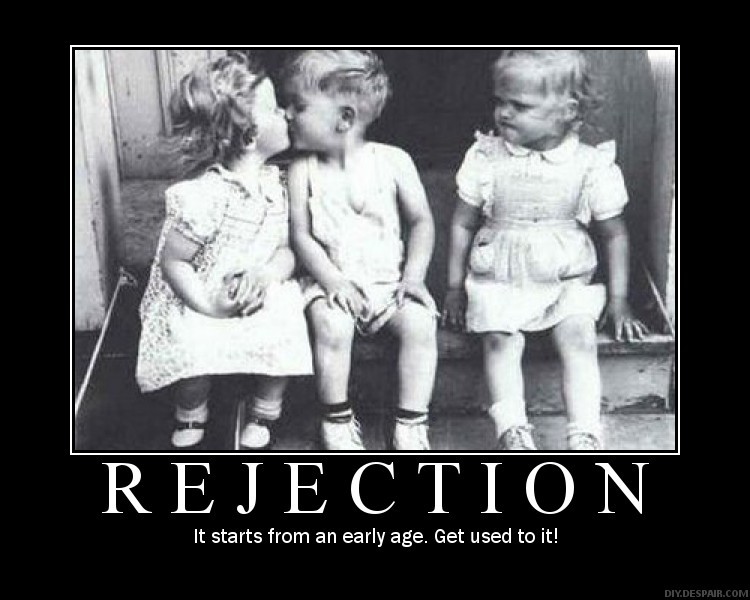
If I can disagree a bit with the image at left, increasingly, we don't learn early on how to deal with rejection. It seems the self-esteem factories of childhood are dead set against letting young people experience anything that could be seen as rejection or a repudiation of their innate wonderfulness.

I am writing this from the very un-objective point of view of someone who just got a rejection letter for a short story he thought was pretty good. But despite my anger (and there's no other word for it) that some hack assistant editor decided my story wasn't worth the time of day, rejection is clarifying. And I don't think we have enough of it in our modern world, especially for young people.

In the worlds of academia and youth activities, we have worked hard to ensure that relatively few people are told their work is inadequate. There's a paint-by-numbers way to get at least decent grades, and there's always an activity willing to celebrate your effort. (Sports remain something of an exception, but only because putting lousy players on the team only delays rejection until the actual game, when you get the ultimate rejection of losing.)

Grade inflation is perhaps one of the more insidious ways that a culture of non-rejection ruins people. A smart student that gets B's and C's because their work isn't quite up to the level of top achievers might be motivated. But when everyone who is adequate gets an "A", the underachiever has no motivation to improve and the overachiever feels cheated and stops working as hard.

Even in dating, perhaps the area most likely to create rejection, the challenges have been lessened. When most people dated with some degree of commitment, the decision to be with a person or not was serious, and a lot of feelings got hurt. Now, young people increasingly have to live with a hook-up culture that discourages serious commitment, but opens the door to casual flings where no one's feelings are hurt, but no one leaves quite satisfied, either.

In adulthood, this translates into no one being willing to tell you that you could be better. I had a long conversation recently with some managers at my company, who said that they were trained to treat anyone under 30 with kid gloves and to overwhelm them with positive reinforcement, lest they become discouraged and quit. Unsurprisingly, those 20-somethings don't seem to be learning how to get better.

That's the value of rejection: it either clarifies your failings or makes you that much more determined to prove the rejector wrong. If we are losing our ability as a society to reject that which we feel is inadequate, we will end up with steadily less excellence, as too many talented people will feel their first, mediocre efforts in their chosen field are good enough. Far better to maintain a culture of high standards, where a little rejection goes a long way to motivating people.

Wednesday, July 21, 2010

The Expert Problem

I was listening to NPR the other day and heard some pundit complain about something I've heard in many venues: namely, that so little of the stimulus money has been spent. This article lays out some of the details, as do many others if you care to look. Why, you might ask, is it so hard to actually spend this money and get some stuff built? After all, there are no shortages of rundown or overcrowded highways, or congested rail corridors, or outdated airports. Let's get to work!

Not so fast. The reason you don't see new bridges and tunnels being built, as happened frequently in the Great Depression, is in large part because we now have experts to clutter up these projects. Nothing gets done by the people who make things without the people who think about things having their say first. In many ways, the white collar worker is the enemy of his blue collar brother, as the reports, analyses and meetings of the former slow up the building, creating and manufacturing of the latter.

Just take a look at this page updating on progress for the Second Avenue Subway line here in NYC: you see study after study, recommendation after recommendation, but words like, "dig" are barely to be found. A century ago, this city was criss-crossed with subway lines, built largely by private industry. But now it seems it takes decades just to study the possibility of a project. I work a half block away from where the proposed line will run, and strongly doubt I will ever ride it.

Obviously, there is merit in looking before you leap, and considering the best way to execute a project as well as its possible impact before starting. But projects like the Big Dig are beset by cost overruns and engineering failures even after the best minds study the problem endlessly, so how much value do all these reports really provide? The country aches for renewal, and improving our infrastructure is part of that. So lets stop the debating and get to work.

Thursday, July 1, 2010

Faith and Knowledge

I just finished reading an interesting piece in Slate by Ron Rosenbaum on agnosticism. It tapped into something that I think is a logical challenge of being a religious believer: namely, that the only way you can be 100% sure your faith is right is to be in some way delusional. Faith is almost meaningless if it ia guaranteed.

Does that make me a religious agnostic? (Or a Catholic agnostic, to be more specific?) I do think the medieval Church would have condemned this line of thinking, but I am not sure the Church of John Paul II, and now Pope Benedict, would. How can one say that religious belief cannot be compelled, acknowledge the legitimacy (if not the truth) of other traditions, and then state that a member of the Church must profess 100% certainty in all of its teachings? To believe is not to know.

And to go further, I think there is a good, theological reason we cannot be absolutely sure of our faith claims, one that has been said many times: to make God undeniable is to remove the free will which is His greatest gift to us. Even within an individual heart, an unearned certainty in one's faith turns the believer from a free soul to an automaton. And history shows that those who are absolutely certain in a belief, whether in the Catholic Church, or Islam, or Communism, or Atheism, or the superiority of a certain race, are likely to do horrible things in the furtherance of their beliefs.

There are few humans so incurious about the world that the question of why we are here will never come to them. And that sliver of a non-materialistic question opens the door to belief. As the compulsion to believe fades from human society, I think religion will get more confused and less hierarchical, but the need people have to 'grow in faith' together (a process more halting and unsteady than the phrase implies) will remain. There will be a purges and renewals in faith, as has happened periodically throughout the history of all the great religions, but the existance of doubt does not destroy, and may increase, the need for organized churches.

Tuesday, June 22, 2010

Personality is Destiny

I am going to start this post by praising Keith Olbermann, a beginning I find so shocking that I had to compensate by including the goofy picture at left. As pointed out in this WSJ article and elsewhere, Olbermann (and other liberals) have been extremely critical of Obama's handling of the Gulf oil spill, and of his Oval Office speech on the topic in particular. What I find so worthy about this is that many liberals are expressing discontent without regard for what it might do to their side's political fortunes. In contrast, conservatives generally held fire on George W. Bush until his second term in office, figuring he had to be better than John Kerry. It is, I think, good for the country when people, regardless of ideology, say what they honestly feel about political decisions, rather than playing the us-versus-them game. It helps us find common ground, even if that common ground is on the other side of the river from the President.

That said, many conservatives hear the complaints liberals have just started making about Obama and respond, "Oh, you're just noticing that now?" For them, Obama's flaws have been evident from early on: he's aloof, he has no experience running anything, he is over-dependant on experts. All of which I would argue is true to some extent, if often overstated.

Perhaps the issue is not what Obama does but, quite simply, who he is. And what he is, at his core, is a man who values success as a goal in and of itself, without caring to much about the wielding of power he achieves. The presidency was just a mountain to climb, and now that he's achieved the summit, he doesn't know what to do next. A Spengler essay from 2009 put it well:

I have never met the man, but I have interviewed a fair sampling of his supporters, and conclude that Obama learned the power to cloud men's minds, like the Shadow on the old radio show. Apart from ambition, there is no "there" there. There are as many Obamas as there are interlocutors.


Was this really so surprising? At one point, he cited his ability to run a presidential campaign as proof of executive experience. People have pointed out how laughable this is on its face, but I have not heard many say how frightening it is that he would equate the task of promoting himself with the task of running the most powerful nation on Earth.

Rather than continue to pile on an already beleaguered politician, though, I'd like to point out that a relatively basic analysis of a candidate's personality seems a much better predictor of their performance as President than their policy positions. Moving past Obama, George W. Bush seemed obviously cocksure, privileged and unreflective even on the campaign trail. Shouldn't we have anticipated he would not adjust well to changing circumstances, that he would retreat, sulking, into a protective bubble rather than spar with a hostile media? (I rather liked the man, all things considered, but I don't think even his most steadfast supporters could deny those two crippling flaws.)

Going back one more, wasn't Bill Clinton a textbook case of a man who would rather be popular than be right? Perhaps a bit narcissistic? I'd argue those traits explain everything from his sexual dalliances to his political strategy of triangulation. His desire to do big, important things like reform healthcare could not compete with the fundamental yearning to be loved and validated by as many people as possible.

One last point, if I may, because I anticipate an objection: If Obama, as I suggest, values personal achievement more than governing, then why did he push so hard for and ultimately get his healthcare bill passed? I would argue that it has little to do with his belief that the policy was best for the country (in the past, he advocated single payer, but abandoned that approach once he announced his candidacy). Rather, he wanted to do something that many Democratic presidents and politicians before him had tried and failed to do, something that would make him better than them. Obama was willing to take a hit to his approval ratings because he wanted to succeed where others has failed.

Why do we as a country continue to vote for candidates with massive (and fairly glaring) personality flaws? I believe it is the nature of our political system. In the primaries, the discontented stalwarts of the opposition party look for a candidate that seems the exact opposite of what they hate in the current president. They overlook (or even embrace) the flaws of this opposing personality, because he seems like a corrective to the despised enemy. In the general election, those flaws are muted, and the independent voter generally embraces someone new and different. It is only in the (increasingly rare) cases where a president finishes two terms with their popularity intact (like Reagan) that this dynamic is less pronounced.

If the model holds, we will in two or six years elect a leader whose personality is diametrically opposed to Obama's. And then feel a pang of regret when we realize we've made the same mistakee all over again.

Tuesday, June 15, 2010

On Being First

I am reading World Without End, sequel to Pillars of the Earth: both books are about medieval England, and the assortment of craftsman, priests, nobles and visionaries that either impede or advance the efforts to build, respectively, a bridge and a cathedral in the fictional town of Kingsbridge. Along the way, the characters kill, make love, go on journeys, try to ruin each other, and do all the other things characters do to fill out two 800+ page popular novels.

But what really interests me is the way the author, Ken Follett, captures the nature of how progress is made. Both books are driven by characters who solve seemingly intractable problems through intellect and force of will, doing things no one else in their community could have imagined.

But the interesting thing is that many of the solutions they come up with seem, to the modern reader, clever but not particularly ingenious. One example: in World Without End, the main character builds the foundation of a bridge by driving stakes around the area where the pillars will go, then filling the gaps between rows of stakes with clay to block the water. Clever? Absolutely. But not revolutionary, at least not to modern minds, even though few if any of Follett's readers have done anything similar.

What you realize upon relfection is that it doesn't seem so revolutionary because you know similar things are done all the time. You might have to reason out how to do it, but you know it can be done. It is much harder to ask yourself, about something that has never been imagined before (at least, as far as you know), "Can this be done?" Follett's characters win us over because they are always asking that question, and overcoming the obstacles in between them and their goals.

Being first to do anything is hard, especially in hard times like these when the easiest thing to do is play it safe and wait for things to improve. But human progress is the accumulation of knowledge gained as people try something first, and then a lot of other people applying that hard-earned knowledge to their situations. In any walk of life, there is the possibility to try the untried, and perhaps to prosper by doing something totally new.

Wednesday, June 2, 2010

Declining Opportunities for "Earned Success"?


I am quite intrigued by Arthur Brooks' arguments about "earned success", which I have seen in several places but which are summarized nicely here. To briefly summarize, Brooks suggests that it is not ultimately income that correlates with happiness, but the feeling that our success (which yes, is often reflected in earnings) is the result of our drive, and that we have contributed in some way to improving humanity's condition. Whether that is by solving a scientific problem, making something useful for someone else, or creating beauty doesn't matter.

I agree with the notion, but I find it mildly depressing, because I believe that the future will offer fewer professional opportunities for earned success. Most of the people I know (and admittedly, New Yorkers and other northeast urbanites/suburbanites are an unrepresentative sample) do not feel their jobs are contributing towards anything bigger, at least not in any way they can observe.

And the future seems likely to create more of the same. Most of the jobs created in the western world are based on various types of information manipulation: packaging facts and ideas for consumption. It may be lucrative, it may even be challenging, but it quite often feels detached and utterly meaningless to the people in these positions. Our corporations, our systems of production and distribution, are so large that few people really have a view of how their contribution fits in. In other words, they feel they are part of a machine and not in control of their own success. This is even happening in healthcare, where doctors and nurses frequently complain that they spend much more time doing administrative tasks and less tending to patients.

This is not cause for despair, exactly. There will always be jobs in research, in the arts, and in engineering that offer what corporate positions increasingly do not: a sense that your effort makes an impact. And for the rest of us, we may have to find earned success in our families or our avocations as we are denied it in the working world.

Wednesday, May 26, 2010

It's the Energy Source, Stupid

For my entire life, the energy of human innovation has been focused on the individual: we have seen the advent of the computer, the cellular phone, and then the infinite improvements, iterations, and combinations of those technologies. When you read a "BLANK of the Future" article, whether that blank is filled in by "Car", or "House", or "Hammer", you can bet it has something to do with the microchip or wireless communication.

In fact, the only other trend that has had a major impact on the things we use has been incremental improvements in materials, allowing us to build things stronger and lighter. (Note, I'm sure someone could find a technology to prove me wrong on this, and I'm purposefully ignoring healthcare innovation because--well, because I want to.)

Now, as I've written before, what we have not innovated on is what I'll call 'collective technologies': things that affect a lot of people, but that individuals rarely 'own'. (Think railroads and other forms of mass transportation, or other infrastructure.) These have been improved in recent years, but there hasn't been anything like a major breakthrough: just incremental gains, caused mostly by improvements in materials and the introduction of the microchip into older technologies.

When I read things like this, then, about the need to establish an economic reason for further space exploration, I'm in complete agreement. But the author is stealing a base: there is simply no way, with the technology we have, that we are going to see space mining or any other sort of economic activity pay off until we have an energy source that makes space transit much, much more efficient.

Think of it this way: the ascension of oil as the dominant energy source (and coal to a lesser extent) made possible every single transportation improvement over the last 150 or so years. Before that we had very inefficient, unreliable wind, water and steam power. Fossil fuels represented an order of magnitude improvement, and it took about a century (until Apollo, arguably) for us to push the limits of where that energy source could take us. Since then, no major breakthroughs on collective technologies. Why? We're waiting for the next energy source that can offer an order-of-magnitude gain on the current standard.

And just so we can skip to the point, that ain't going to be fuel cells, and it ain't going to be wind or geothermal. Maybe solar can step up, if we create much, much, MUCH more efficient panels. Otherwise, it has to be fusion, or something the vast majority of us haven't heard of. But if you want to get humanity off this rock and into a solar-system wide economy, don't worry about what NASA is doing, invest in energy research.

Thursday, May 13, 2010

How the Supreme Court Threatens National Cohesion

Every time a new nominee is put forth for the Supreme Court, there is a lot of opining about what it means for the country, whether the nominee will tilt the balance of the court, and, as in this post by Ross Douthat, whether there should be term limits or other mechanisms to make these nominations a little less momentous.

In the course of discussing term limits, Douthat quotes blogger Matt Yglesias as saying, "The most important consideration for the future of American law is not whether Justice Kagan turns out to be more like Breyer or more like Stevens, it’s whether the seventy-four year-old Antonin Scalia can stay in good health until there’s a Republican in the White House." This hits at the heart of the problem with the court, but it is not one I think can be solved by term limits.

The problem is this: the only reason that the decisions of the Supreme Court have not caused major problems in this country so far is that justices have had the courtesy to leave or get ill at a time when the current President would replace them with someone who would carry on their ideological torch. This has happened somewhat accidentally at first, with Republican presidents nominating justices that would turn out to be liberal. But since Jimmy Carter, we've had somewhat consistent back-and-forth between Democratic and Republican presidents, who have (with the exception of Souter), always nominated someone more or less on their 'team'. There are decisions that are unpopular with one side or the other, but the Court seems within the mainstream of American politics, more or less.

But what happens if, as an example, John Roberts and Samuel Alito are in a fatal car accident next week? Suddenly, the two Bush justices, who were supposed to be reliably conservative votes for decades, are wiped out, and Obama is going to pick their replacements. The Republicans can filibuster a hard-left liberal, but they have to let someone through. Now the court is six liberal votes (four of whom Obama picked, and will serve for a long time in all likelihood), two conservative votes (and one of them 74 years old) and Kennedy, whose 'swing vote' power is now meaningless. Even if the Republicans defeat Obama in 2012 and hold the presidency for the next 20 years, they might not get a chance to do more than replace Ginsburg and Breyer. And who knows, one or both of them may retire soon to ensure Obama replaces them, too.

A court of that composition would certainly never consider adjustments to Roe v. Wade, would likely strike down restrictions on gay marriage, may well curtail gun ownership rights, and would be inclined to extend and expand racial preferences. No matter how you feel about these issues, it is impossible to deny that not giving conservatives any recourse on a number of issues that matter greatly to them would strain the political system immensely. I once drafted a novel with the premise that assassinations on the Supreme Court precipitated the breakup of the United States. Hopefully that never comes to pass, but it is undeniable that the Supreme Court is not only our least democratic branch of government, it is the most unstable and unpredictable. It is thus a likely source of future instability in the country.

Monday, May 3, 2010

Too Complex to Fail? Debt and Modern Government

You are, I've often been told, supposed to write about things you understand. Which is why I should not be writing about the ongoing financial crisis: I can't understand what's happening. From an outsider's perspective, it certainly seems like the numbers don't add up. Our national debt is building at an unfathomable rate. Greece just required a bailout of over a hundred billion dollars, and most experts seem skeptical that it was enough. The nations of the developed world all have massive amounts of public and private debt. (Check out this page on 'external debt' if you want your mind blown.)

I have generally taken it as a given that the bankers who lend money know what they are doing, and despite an amount of debt that frankly seems impossible to pay back, there must be enough corresponding assets that it would all work out. After all, we generally compare debt to annual GDP output, but there are many past years of wealth built up that could pay off debt in a crisis.

However, these two posts by David Goldman have forced me to start thinking that our elected officials, rather than confront the crisis of debt, have made a deal with the devil to keep government going the same way it always has without making anyone too uncomfortable. What we should be doing, in a common-sense world, is dramatically cutting spending and raising taxes to pay for our profligate ways. But that would raise unemployment, make the recession worse, and get all the politicians thrown out of office. So they are instead letting bankers make a lot of money by borrowing from one branch of government and using the money to buy debt from another branch of government. This sounds an awful lot like money laundering: an illegitimate enterprise gives money to someone else for a legitimate use, then they pay back the criminals in clean money. Only in this case they are trying to hide the fact not that they made the money illegally, but that they made the money out of nothing: there's no wealth behind it, nothing but the guarantee of a country rapidly losing control of its finances.

At the risk of piling on too many metaphors, the whole thing feels like a NASCAR race where the cars keep going faster and faster. Eventually they're speeding so fast that it is obvious to everyone that the race has become unsafe. They need to slow down. But the cars are packed so close together, if anyone so much as taps the brakes, there will be a massive pileup. So everyone keeps accelerating, knowing they're just putting off the crash, hoping for some miracle to save them. We have so much debt, so much money moving around so fast, I don't think anyone really understands exactly what's going on. But I keep bracing myself for the moment when some big lender or country finally flinches, and taps on the brakes.

Tuesday, April 27, 2010

The Future in Assassinations

Every once in a while, when I'm looking to learn something completely new and random, I head over to DARPA's website, to browse around and see the possible technologies of the future. And today I found a little gem: the Extreme Accuracy Tactical Ordinance (EXACTO) program.

By way of a brief summary, DARPA paints the picture of an extremely accurate 50 caliber rifle with maneuverable bullets, which it claims will radically increase the range and accuracy of two-man sniper teams. It vaguely mentions a 'real-time guidance system', but understandably doesn't say more. There's no mention, of course, of how close this technology is to full development. (I'm not the only one to find this fascinating, it also received a write-up at WIRED.

My initial guess is that DARPA hopes to create something like the laser-guided smart bombs that have been used in our recent wars. In this case, I can imagine a spotter who gets much closer to the target and lights him up with a laser (the range of the laser obviously becomes important here). Then the bullet would have some sort of fins that allow slight adjustments to hone in on the spot. However, its also possible the technology would allow the target to be marked in advance (imagine a James Bond type sticking something to the back of a jacket) so the spotter can get away before the shot is fired.

According to a quick web search, the farthest shot to kill a human target ever was about a mile and a half. If this technology can double that and make such long-distance shots more accurate, assassinations would become easier by an order of magnitude. (Imagine being in charge of securing all the possible firing positions within over 20 square miles.) But the interesting question is whether and how we would use this technology if we had it available. Right now, we're using Predator drones to kill a lot of Al Qaeda types. In the future, will we once again opt for the bullet over the bomb? Or is ordering a person shot, instead of a target bombed, a little too real for leaders detached from the fight?

Wednesday, April 21, 2010

Madness? THIS. IS. PARIS!

The picture to the left depicts some modernist architect's vision of an updated Paris. And while it might be hard to imagine a sophisticated (read: wimpy) Parisian parroting Leonidas' words from 300, I'd argue Sarkozy, the French leader trying to implement a massive modernization plan in the City of Lights, deserves to be dragged to the top of the Eiffel Tower and thrown off for his treachery. The thought of turning the world's most harmonious and beautiful city into the set of Blade Runner 2 is more than I can tolerate.

David Brussat, the tireless architecture critic writing for the Providence Journal, routinely highlights the many modernist horrors inflicted upon our great cities. And I am right with him in believing that the current style of architecture is a destructive force when applied to existing cityscapes.

Yet, the part of me that thinks we have abandoned the search for the future to better enjoy the familiar comforts of the past knows that without experimentation, a city risks becoming a museum. So what to do? I think you can find a hint of the answer in New York. While the city has its classical structures, it embraced the latest techniques and trends of the time of its great expansion, the 19th and early 20th centuries. The skyscraper works in New York in a way it simply cannot in Paris, because the development happened organically and the cityscape was built around this new form.

The new styles and building techniques are not going to originate in New York, or Paris, nor should they. The growing cities of the world (for example Sao Paolo, or Shanghai) should look for approaches that solve their unique problems, and these solutions will diffuse to other cities. And even more importantly, when we find ourselves building under the ocean, or on Mars (assuming we ever do) those environments will reflect new needs and new thinking about the best way to live.

The other option is to destroy our built heritage and model our urban cores after Dubai. That is to say, a series of monumental, impressive buildings that fail to congeal into anything like a liveable, cohesive cityscape. But if that comes to pass, I think we'll have a lot of architects and leaders that we want to throw off the top of their monstrosities.

Friday, April 16, 2010

The World in 2200: Part Three

In the two previous posts in this series, I examined some social trends that I believe will be significant drivers of our future, and then hypothesized about the type of events that would happen in a world where those forces were shaping history. In this post, we'll take a look at how this world might appear to a typical citizen of New York City, a physician named Zeke.

At 8:30, Zeke bought a soy bagel and walked to his customary bench in Battery Park, where he would scarf down breakfast. It was Wednesday, so he'd get to see the weekly Mars Cruiser launch from the Jamaica Bay spaceport. Not for the first time, he wished he was on it: the biggest city on Mars, Anconia, was a model libertarian community, and he was increasingly feeling that life in old Manhattan was a little oppressive. He looked at the solid old scrapers of the Wall Street historic district: nothing new had been built there in about 150 years. The streets were closed to vehicle traffic both to preserve its tourist appeal and so no terrorist could bomb the old buildings into rubble. In Brooklyn and Queens, where more new development took place, the buildings were engineered to take a lot more. Just last month, a Bolivarian freedom fighter had driven an old electric van into the base of the Twitter Tower in Long Island City, and the blast had done little more than crack a few lower windows.

Zeke pulled out his thin-screen reader and unfolded it. Its smart cells snapped it rigid after it was fully expanded, and he quickly downloaded the print and video feeds from the Huffington Times. He glanced up as the Mars Cruiser fired its big fusion-powered jet, then went back to reading about a plan for Indian Buddhists to set up "New Tibet" in the asteroid belt. The Chiinese were objecting, as they claimed there was no country named Tibet that it could be named after. Zeke chuckled: he remembered the settlement between India and China after their last scuffle, 20 years earlier, and how China had to keep Tibet because neither side wanted to attract the wrath of the Warriors of the Lama, nor did India want the challenge of an independent base for its dissident Buddhists to rally around. Now, like it had for so many nations with unhappy minorities, it seemed that space would solve the problem.

He then watched yet another debate about the legality of genetic enhancements in children. It seemed besides the point to him. Like most physicians, he saw many patients who had obviously been 'upgraded' in some way or another, and despite the laws he never reported his suspicions or gave evidence to investigators, even when the mods were obvious. (One of his patients, an avid diver, always wore turtlenecks to hide his gills.)

Before he shuffled off to work, he noted that the Southern Autonomous Region was threatening to declare total independence again. The new wrinkle was that now Washigon (he still hated that name) was claiming that if the South went, they would form a new state with British Columbia, which was already independent of Canada. Zeke wondered how long the US was going to hold together: with all the independent space colonies, it seemed like every region with a few million people thought it could and should run itself. "I might be old-fashioned," he thought, "but I still rather like the idea of one big country, even if I don't much care for some of the decisions the government makes."

He folded up his paper-thin screen, threw his trash into a disintigrator (The motto of Waste Repurposing: 'The building blocks of tomorrow's...Whatever!' was cheerfully printed across its side) and headed to his office. His local patients would start arriving at 11:00, for the first two hours, he was required by law to practice vid-medicine for patients in Africa, as part of the Emerging World Grievance Resolution Treaty of 2182. The compromise was that American doctors didn't have to move there. He consulted with a few patients in Great Congo, who all had easily resolved complaints, then finally saw his first live human promptly at 11:00. The poor woman had been suffering from Grant's Syndrome for weeks, and had not been able to get an appointment before now. It doesn't make sense, thought Zeke, that the 'disadvantaged' countries could get better care than the 'modern' ones. He imagined things were better on Mars.

He walked home after work, happy he wasn't one of the people screaming all over the northeast on one of the new MagLev Commuter Trains. Part of the recent "Renewing America" program, they could get a person from Ohio to New York in 70 minutes. But the damned things were still unreliable, and they were packed for almost every run. He supposed they were good for the economy, but they had made New York more crowded than it had been in quite a long time.

In his apartment, his wife had left a holo-message to say she'd be out late with friends, and his son had left for his weekend trip to Moscow. So, with a free evening for the first time he could recall, he played his favorite Virtual Reality war game (relive the epic battles of the great South American wars of the 2080's!) and downed a bit of his illicit scotch. He would be damned if he gave up the occassional drink because he was over 50, and the bureaucrats thought it would increase his medical costs. He was a doctor, and could take care of himself. Eventually, his wife still not home, he drifted off, thinking about how nice Mars sounded.

Monday, April 12, 2010

The World in 2200: Part Two

In my last installment of this brief series, I attempted to identify some driving trends that could exert significant influence over our next two centuries. (Full disclosure: I somewhat arbitrarily picked that amount of time.) In this post, I will attempt to outline some representative events you could expect to observe if I am correct. These specific events are highly unlikely to happen, of course, but the point of the exercise is not to make a prediction, but to model what the rough shape of our future might be.

1) The great Indo-Chinese war:

Every prognosticator likes to line up two combatants for a big battle over the future. If you forced me to pick my two adversaries, this is where I would look, though I wouldn't expect it all that soon. As I mentioned in my last, China doesn't quite fit into either the rich/old/materialist or the poor/young/spiritual camp. I believe, in the words of Mark Steyn, that China will get old before it gets rich. Its government trades authoritarian control for a rising standard of living, and as they catch up with the West on the one hand, while trying to support a more geriatric population on the other, their economy will slow. This will put pressure on the government and make it more belligerent. India, meanwhile, has the potential to be more vital due to its growing population and open political system. It will also likely be allied to some degree with the US, making it feel secure. As it grows powerful and affluent, it may become economically dominant in areas China once controlled. The competing spheres of influence may force war, although it will probably bear little resemblance to the battles of the 20th century, as robotics and digital warfare will play a major roll. In general, any young, growing nation that can organize its economy to allow growth will clash with the entrenched interests of the old, rich nations trying to hold on to their inherited advantages.

2) Extreme political affiliation:

We might feel like we're already there, but I assure you that politics could get a lot uglier. As the Internet allows each individual to choose the information that most conforms to their view of the world, it becomes ever easier to avoid reading or hearing anything that contradicts your opinion. Eventually, this will lead to such a radical divergence of opinion that some groups will find it impossible to live with another. A trend that will start as families moving to more agreeable towns will accelerate so that colonies (whether under the oceans or off the planet) will be founded for like-minded people, and powerful nations will be under strain to break up as those with wildly divergent viewpoints cluster together and reject the compromises of diverse democracies.

3) The new energy

In my last post, I speculate that we will hit the limits of 'convenience-focused innovation', or products and services that are targeted at individual welfare and happiness. To expand on the thought, I think we will hit a natural limit of how much further we can innovate without a fundamental transformation in the power that drives all our stuff, and how we transmit and store it. First, the major advances of the future will probably require exponentially more energy than the incremental advances of our current technology base (which I would define as being based on the microchip and the internal combustion engine.) When we develop a power source (I still think fusion makes the most sense, but we've been working on that for a long time with no great results) that can generate much more energy (and, secondarily, better battery technology that can store that energy better and deploy it in a wide range of stuff), new vistas of innovation will open. But until that happens, we will start to see diminishing returns as more and more expensive innovations deliver more and more marginal improvements in our quality of life.

4) We will negotiate with terrorists

Terrorism stinks as a strategy against an enemy in about the same circumstances as you: you are losing your most dedicated soldiers and inflamming your opponent with your cruelty. And it doesn't make much sense against a ruthless enemy, because the amoral response to terrorism is to wipe out the people that are supporting and supplying the terrorism. But it is great as a strategy against a much richer and more powerful enemy with a lot to lose, if your goal is to get marginal concessions. In a way, the model isn't Islamic terrorism, it is the Irish terrorism of the 1970's and 1980's. Your goal can't be to destroy your enemy, but get them to give you something you value much more than them. And then have a 'terrorist' wing distinct from a 'political' wing. Ideally, you ensure there is no obvious connection between the two, so the enemy can negotiate with the political wing without giving the impression that they are responding to the terrorism. As the western nations grow old, they will be ripe targets for this type of approach, as they will be living off the accumulated wealth of the past and thus prefer a slightly dishonorable peace to seeing their (relatively few) children sent off to fight. The only problem is that their enemies will keep nibbling, with each outbreak of terrorism getting slightly bigger concessions. The balancing act is to go far enough that the terrorism threatens to disrupt the enemy's happy life, but not so far that the people get outraged enough to fight back. Expect to see the strategies of terrorism refined over this century.

So, what might it be like to live in this world? I'll cover that in my final 2200 post later this week.

Wednesday, April 7, 2010

The World in 2200: Part One

I had a thought, on my long and lovely vacation to Ireland, staring at ruins of churches and castles that had been dotting the countryside for hundreds of years, that it might be fun to do a little speculating about our somewhat distant future.

Now, I'm not going to try to make any hard and fast predictions about specific events that will happen, but I thought I could do a brief series that would outline where I think we're going and what it might mean for what it means to be a human being in about 2200. I intend to write three parts: in this first one, I'll identify five drivers that I think will be major shapers of the future. In the second, I'll point out some of the types of things that will happen if my drivers end up being as influential as I think they'll be. And in the third, I'll compose a brief sketch of how a citizen of this 2200 world might perceive his civilization.

To get to it, here are five driving forces I think will profoundly shape our world over the next 190-or-so years:

1) Divergent Demographics

Over the next century, we will see a number of nations (specifically in Western Europe and Japan) continue to accumulate wealth while having fewer and fewer children. These nations will become old, rich, and materialistic. At the same time, there will be a number of nations in the traditional third world that will be young, poor, and spiritual. Will the old nations fight to maintain their dominance over economics and culture? Or will they gracefully hand the world over to the nations with youthful energy? The two exceptions to this trend are, on the one hand, the USA, which will stay rich while remaining relatively young and spiritual, and China, which will rapidly age as a result of its one child policy while the vast majority of its population is still poor.

2) The Limits of Convenience

In the past few decades, wealthy nations have increasingly put their capital and top minds to work on creating products and services that make life more convenient and fun for individuals, rather than investing in exploration, infrastructure, or elite culture (which were traditionally the larger areas of investment). For many decades, science and business will continue to find ways to improve the individuals well-being (think genetic engineering), but this drive to make life more comfortable and pleasurable will generate diminishing returns. There will be a backlash as people demand their lives have more meaning, and a renewed desire among our entrepreneurial elite to make "giant leaps for all mankind."

3) Communities of Choice

The Internet has given us a peak of what happens when we can choose exactly where to get our information. In the next two centuries, we'll be increasingly free to choose every aspect of our environment. I predict in the relatively near future the upper and even middle classes will increasingly country-shop for a nation or community that fits them, and opinions and beliefs will polarize as we increasingly only see and hear what we are predisposed to like. Further out, the desire to live life 'just so' will lead to Pilgrim-style space colonization. Mars won't be settled by a country, it will be settled by religious our scientific dissidents who want to remove themselves from the dominant culture of their day.

4) Techno-Warfare

As societies become more networked and more dependent upon computers (and eventually robots) to make day-to-day life work, they will be increasingly vulnerable to interruptions to their networks and computerized infrastructure. Massive attacks on the technological underpinnings of a nation will serve the role of saturation bombing in World War II: an attempt to sap an enemy's will and ability to fight. Only in this case, an increasing squeamishness about taking life (especially in low-birthrate nations) will mean this form of warfare exists somewhat independently of bullets and bombs. Victory truly may not require a shot.

5) Terrorism as Leveler

Of course, the above only applies if you fall into the old, rich and materialistic side of the demographic divide outlined in item one. If you are a younger, poorer and more spiritual nation (or ideological organization, as you might see form based on item three), a loss of life may be more than justifiable. Expect terrorism to evolve from a dramatic act with limited political payoff to a dramatic, focused activity directly linked to achievable political goals. In other words, we can expect a war to be won with terrorism as a primary weapon. The 'old' nations will negotiate with terrorists as a means to preserve their comfortable lives before they fade into history.

All of these trends are visible in nascent form today, but I think we can expect them to accelerate and mix in the coming decades. What that may look like is the subject of Part Two.

Monday, March 8, 2010

The Truth Sort of Sucks

I probably shouldn't blog in the frustrated mood I find myself in, but a thought keeps demanding its way out of my brain, which is somewhere between self-pitying fatalism and a fact. It was brought out by this profile of NY Times columnist Ross Douthat in the liberal magazine Mother Jones. Essentially, the writer notes that Douthat is a thoughtful, intelligent conservative, and then dismisses his beliefs and ideas as totally irrelevant to the way the country is governed.

I'd like to argue this is untrue, but the reality is that our entire system of governance seems to be based on a basic understanding: Liberals (or Progressives, which here might be the more appropriate term) will push as rapidly as possible to expand the reach of the state into the lives of individuals, and conservatives will use their time in office to lower taxes and loosen a few business regulations, juicing the economy so it looks prosperous enough to manage the next progressive encroachment.

The genius of the United States (and really the English political culture that spawned it) was to accept that people could, in a society of laws, learn the rules and basically manage for themselves. But the essential post-Depression shift has said that people can't take care of themselves, and the government needs to be there to prop them up. But when that assumption applies not just to the relatively small number of people who really can't take care of themselves, but to a majority that could but would find it easier not to, the government needs to take on powers inconsistent with a basically free nation.

In a way, I think, the retirement of the Baby Boomers represents America's retirement. As a society, we're going to increasingly be living on the savings, if you will, that we made over hundreds of years of entrepreneurial risk-taking and non-intrusive government. The only problem is that retirees either die or go bankrupt. Countries, except in the most tragic of scenarios, lack the first option.

Saturday, March 6, 2010

Thinking Honestly About Healthcare


I am amazed (and more than a little dismayed) that after years of debate about government intervention in the healthcare system, that there is still almost no rational conversation about the need to make tradeoffs to ensure better coverage for more people. Basically, the assumption on the right is that we already pay a lot of money to cover seniors and the poor, and we can't afford to massively expand government to increase benefits further. The liberal response is that it is a moral imperative that everyone have healthcare, and besides it will be more efficient than the system we have now. (For a nice summary of these arguments, read this Ross Douthat post and the responses below.)

But all of these arguments fail to account for the rapid pace of healthcare innovation. Or if they do account for them, it is with the assumption that everyone is entitled to the latest medical breakthroughs as soon as the FDA approves them. And I suppose, if you view 'health' as a right without any context, that makes sense. But that view, barring an amazing breakthrough that radically lowers treatment costs for chronic diseases, leads directly to national bankruptcy. The costs of new therapies, and the prevalence of heart disease, diabetes, cancer, Alzheimer's, and other conditions, will combine to swamp us.

Let's just talk about death for a second. (Sorry for the downer.) There are about 43,000 automotive deaths a year. A recent study (which I will for this argument accept uncritically) projected that there are about 45,000 deaths a year associated with lack of insurance. Now, lets hypothesize that automotive engineering advances, and new cars on the market dramatically reduce accident deaths. Putting people in the riskiest vehicles into these new cars could dramatically cut into that mortality rate. Would that be a moral imperative? Is there a right to these new safer cars? I think most would argue that the cars are a blessing, but would expect them to gradually replace older cars over time, and would accept the inevitable loss of life in the interim as an unavoidably tragedy, part of the cost of slow, uneven human advancement.

A lot of people, I'm sure, would say this is a ridiculous argument. But the cost of health insurance, annually, is priced somewhere between $5000 and $7000 per adult. That's somewhat more than my annual payments on a (very safe!) Honda Element. And don't expect those costs to go anywhere but up in the future. Most of the drugs being developed aren't easy-to-mass-produce chemical compounds, but more exotic and costly treatments like biologics, which are now used to treat everything from cancer to arthritis to psoriasis. The cost of a year on Enbrel therapy, for example, is about $12,000. These drugs aren't just more expensive to develop, they're more expensive to produce, so even the eventual generic versions will be expensive compared to the drugs we're used to.

So here's my point: I'm in favor of expanding healthcare assistance for those who can't afford their own insurance, but it should acknowledge the reality that some of the newest drugs may be too expensive to pay for in these plans. If I were to sketch the rough outline of such a plan, it would cover generic drugs, basic preventative care, and some sort of catastrophic coverage with a high deductible that would protect against life-threatening problems. (Over time, I would apply this model, with some variations, to existing government healthcare programs.) Will some people have sub-optimal outcomes on this plan? Absolutely. But the idea that we can afford to give everyone access to the latest healthcare innovations is a puppydogs-and-ice cream fantasy we can't afford to indulge in.

Sunday, February 28, 2010

Dot Connectors Wanted

I read this past week a fascinating exchange by Shane Harris, author of a new book called The Watchers, and Patrick Radden Keefe. Both of them have covered the various controversies over government spying and data collection, and Harris' book takes a deep look at John Poindexter and the Total Information Awareness (TIA) project that created a stir during the Bush administration.

What struck me, as I read the exchange, was their observation that the government has become good at "collecting the dots", without increasing its ability to connect them. TIA was meant to automate this process to some degree, but when they ran tests on its effectiveness it failed. The job of connecting the dots, it seems, cannot be outsourced to computers, at least not yet.

So that begs the question: are we failing to teach human beings to connect the dots? This seems like one of the basic building blocks of both wisdom and creativity, and yet it is a skill in short supply. Part of the problem, I think, is that people are increasingly encouraged to specialize: don't just know advertising, be a strategic planner. Don't just do advertising, do healthcare advertising. Don't just know healthcare, know oncology. (Just to cite a personal example.) While that intense specialization might help a person find the conventional answers within their space faster and better, it does not help them incorporate new knowledge from other areas that might revolutionize their area of focus.

The explosion of knowledge made possible by the Internet rewarded specialization, as there is just more to know in every field. Yet in many areas, the dot connectors have been left out, and each isolated topic has tapped a lot of the value it can get out of specialization and narrow focus. The dots have been collected, and the future will belong to those people who can take the critical step of connecting them.

Monday, February 15, 2010

The End of 'Europe'


Last summer, my wife and I took a wonderful trip to Greece. The weather was delightful, I saw some amazing archeological sites, we ate some terrific meals...the usual events of a happy vacation. But in the midst of our good time, we had to twice dodge riots occurring mere feet from our hotel in Athens. We didn't think much of it at the time, beyond registering mild amazement that the rioters seemed to feel it was the government's job to provide them with jobs.

But reading now of Greece's increasingly acute financial problems makes me think that the riots, and the attitude that drives them, are central to an understanding of Greece. As the blogger Spengler and his correspondent point out, the country is infused with corruption and graft of epic proportions. Everyone is trying to get on the public payroll, and many of them don't expect to do much work for the privilege. The country finances an unsustainable amount of spending to keep all these connected operators happy.

And how were they able to keep borrowing to this point? Because they're part of the Eurozone, and lenders have assumed that the Frances and Germanies will keep the peripheral nations from going under. And maybe they still will, but their voters seem unenthusiastic about sending their money to help out countries that have already received a huge economic boost by being included in the European economy.

Not long ago, Greece was a poor country. Its inclusion in the European experiment has given its people a taste of a good life they never really earned. Greece has no great industries, and its public sector is far too large, its social benefits far too generous for what it produces. As great as its cultural and natural gifts are, tourism isn't enough to keep it afloat.

When the productive nations of Europe realize that this scenario isn't limited to Greece, and that a pan-European economic system is a drag on their futures, they're going to demand out, or else kick out the parasitic nations at the periphery of the continent. And that, over a longer time horizon, is likely to render large patches of Europe less charming, prosperous and peaceful than they are today. We will miss visiting those places almost as much as their citizens miss the brief burst of prosperity bought on credit.

Friday, February 12, 2010

Space and the Modern American

As a neophyte science fiction writer, I find myself daydreaming about the different ways we will reach the planets and then the stars with some regularity. For most Americans, from our President on down, space exploration seems like an afterthought, of much less technological interest than the latest iWhatever, of much less cultural significance than Jersey Shore. Thus the announcement that we're essentially warehousing human exploration of space.

The political response to this from some quarters of the conservative movement is that Obama is taking a step away from American Greatness. However, he isn't doing anything more than reflecting our apathy about space exploration in his budgeting decisions. As this article by Craig Nelson notes, George W. Bush's announcement of a mission to Mars was just a bit of political fluff, and almost no one is willing to extend themselves to push for publicly-funded space flight the way JFK did in the early sixties.

So, while the Russians now have a seeming monopoly in sending people into space, we have to ask ourselves what the future holds. Are we destined to stay turned inwards, extending our lifespans and cushioning ourselves in conveniences and amusements while the rest of the galaxy remains a mystery? Obama has cited the possibility of private enterprise taking up some of the slack for NASA. But until the corporate world finds ways to make money in space, that's not going to happen.

Ultimately, I think the lack of interest in reaching space is cultural. First, we have become an incredibly risk-averse species. Most of our political debates now are about how to ensure there is ever-less risk of bad things happening to people. That attitude does not mesh well with the notion of sending many of our best and brightest into situations where they well may die (and die with TV cameras on them, which makes it that much more politically difficult). Secondly, we have lost the idea of the frontier, that great things can happen if you're willing to leave your stagnant past behind and take a leap into the unknown. It has, I'd argue, been replaced by the notion of moving as a lifestyle upgrade. You don't relocate to the place where life will be harder but you can build something for future generations, you relocate to the place with better weather or more Thai restaurants. Having moved to Brooklyn for just that reason (well, not literally the Thai food), I am not condemning anyone for making that choice, but I wonder what our future holds if no one is willing or able to choose the frontier.

Friday, February 5, 2010

Only Be Different

I find politics an interesting place to study communications because all the polling and elections provides rich feedback as to what works and what doesn't. And right now, we are clearly searching for novelty. Look at the low poll numbers for each party, look at the unpredictable voting results (Obama won Indiana and North Carolina in 2008, Republicans won major races in New Jersey and Massachusetts in 2009).

Which is why I find the current strategies of both parties so pathetic. The one thing they seem completely unable to deliver is novelty. Now I don't mean novelty for its own sake, I mean looking at the issues and proposing a completely new, bold solution instead of rehashing previous positions (like the Republican's latest plan.)

Imagine, for example, if someone came out and said, "I propose a two year hiring freeze on all federal government jobs outside the military." They'd have your attention, right? Or, to take on another issue, "I propose every American under 65 have 'catastrophic health insurance' for any illness or injury with average treatment costs over $100,000." OK, one more: "I propose that the government stop issuing marriage licenses and provide domestic partner licensing to any two people who want it."

Now, I chose those as examples because they represent three points I believe in, but they may not fly as national policy. But any politician who said them would instantly get more attention than a Republican who talked generically about tax cuts or a Democrat pushing for a healthcare 'public option'. Because those ideas are old, stale, and predictable.

In marketing, we constantly ask if an idea is 'differentiating', but we use the word incorrectly, to mean "can my competitor say this, or have they said something similar?" But the real definition of differentiation should be "would this create a powerful sense in my audience's mind that my brand represents something unique and valuable?" If we're going to expend the time and money to say something, we should ask ourselves if it will strike anyone as truly different.